
Estimation of Hertzian Contact Pressure during Nanoindentation
Introduction
When a hard indenter presses into a material surface, the applied load is transmitted through an extremely small contact area. This produces very high localized stresses, often reaching several gigapascals even at small loads. Before plastic deformation begins, the contact response follows classical Hertzian elastic contact mechanics.
By estimating the contact radius, one can calculate the contact area and contact pressure, which are fundamental to predicting yielding, cracking, and surface damage. Since real wear involves repeated microscopic contacts between asperities, the nanoindentation contact pressure provides a useful model for understanding tribological behavior at small scales.
Theory
Nanoindentation involves pressing a rigid diamond tip into a flat surface while continuously monitoring load and penetration depth. At very small penetration depths, the deformation is initially purely elastic, meaning that the material recovers completely upon unloading. In this regime, the mechanics of contact are governed by Hertzian elastic contact theory, which describes how two curved elastic bodies transmit force through a finite area rather than a point.
When a spherical or rounded indenter first touches the surface, the contact area is infinitesimally small. As load increases, the surface elastically deforms and the contact region expands into a circular area of radius a. The applied load is therefore distributed over this finite area, generating very high compressive stresses. Because the contact radius is extremely small (typically sub-micron to micron scale), even millinewton loads can produce stresses in the order of gigapascals.
A key feature of Hertzian contact is that the pressure distribution is not uniform. Instead, it follows a parabolic profile: maximum at the center and zero at the edge. The highest shear stress occurs slightly below the surface, not exactly at the surface. This subsurface maximum is physically important because it controls the onset of yielding in ductile materials, nucleation of dislocations, subsurface crack initiation in brittle materials, and early stages of wear damage.
The contact behavior depends on three primary quantities:
- Applied load P
- Indenter radius R
- Combined elastic response of indenter and specimen (reduced modulus E*)
The reduced modulus accounts for the fact that both the indenter and the specimen deform elastically. Even though diamond is very stiff, its deformation is not strictly zero and must be included for accuracy.
As load increases further, the contact pressure may exceed the material’s yield strength (approximately σy ≈ H/3). At this point, plastic deformation begins and Hertz theory no longer strictly applies. Therefore, Hertzian analysis is mainly used to characterize the elastic regime before yielding, or the early stages of indentation.
Because real tribological contacts between asperities resemble repeated micro-indentation events, Hertzian contact mechanics provides a fundamental bridge between nanoindentation experiments and wear behavior.
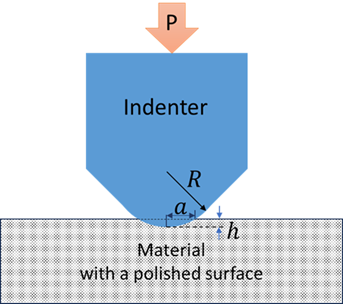
Governing Equations for evaluating Hertzian contact pressure (Figure 1)
Reduced Modulus
Since both indenter and sample deform elastically, the effective stiffness is represented as:
1/E* = (1 − νs2)/Es + (1 − νi2)/Ei
Where:
- Es, νs = Young’s modulus and Poisson’s ratio of specimen
- Ei, νi = Young’s modulus and Poisson’s ratio of indenter
- E* = reduced (effective) modulus
This equation combines the elastic compliance of both bodies. Softer materials give lower E*, resulting in larger contact areas.
Contact Radius
a = (3PR / 4E*)1/3
Where P = applied load, R = indenter tip radius.
This relation indicates that the contact radius (a) increases with an increase in load P and radius R. While “a” decreases with stiffness E*. Thus, a softer material or larger tip spreads the load over a bigger area.
Elastic Approach (Indentation Depth–Load Relation)
h = a² / R
Equivalent form:
P = (4/3) E* √R · h3/2
Mean Contact Pressure
pm = P / A
This is the average stress acting over the contact area A = πa².
Maximum Hertzian Pressure
p0 = 3P / (2πa²) = 1.5 pm
Pressure Distribution
p(r) = p0 (1 − r² / a²)1/2
Where r is radial distance from center.
This equation explains why p(r) is maximum at r=0, zero at r=a and varies parabolically with r/a and thus it also explains why damage nucleates near the center.
Subsurface Shear Stress (Yield Criterion)
τmax ≈ 0.31 p0
Maximum shear stress occurs at ~0.5a below the surface. Plastic deformation begins when this exceeds shear yield strength.
Together, these equations show that contact mechanics is fundamentally a balance between load, stiffness, and geometry. The load determines the force, the modulus controls resistance to deformation, and the tip radius dictates how widely the load spreads. Their combined effect sets the contact radius and therefore the contact pressure. Since pressure governs yielding, cracking, and wear, Hertzian theory provides a direct quantitative pathway from nanoindentation measurements to mechanical performance.
Figure 1
The indenter tip is considered to be the spherical and low loads are applied so as to have elastic deformation (or a minimal plastic deformation) of a material to evaluate contact pressure using Hertzian theory.
Connection between Hertzian Pressure and Wear of materials
Hertzian contact pressure provides a direct mechanical link between localized contact stresses and the initiation of wear in materials. During sliding or abrasive contact, real surfaces touch only at small asperities, and each asperity interaction behaves like a miniature elastic contact similar to a Hertzian indentation. The applied load becomes concentrated over a very small contact area, producing high local pressures. When the maximum contact pressure exceeds the material’s yield strength or fracture strength, the surface undergoes plastic deformation, microcracking, or material removal, which are the fundamental mechanisms of wear.
In ductile materials, excessive Hertzian pressure promotes plastic flow and ploughing, leading to groove formation and adhesive wear. In brittle materials, the subsurface tensile and shear stresses predicted by Hertzian theory can initiate cracks below the surface, causing chipping and spallation during repeated loading. Therefore, estimating Hertzian pressure helps predict whether the contact will remain elastic (low wear) or transition to plastic or fracture-dominated regimes (high wear). Materials with higher hardness and modulus generally sustain lower deformation for the same load, reducing the effective contact area growth and improving wear resistance.